

Bone Conduction Solution
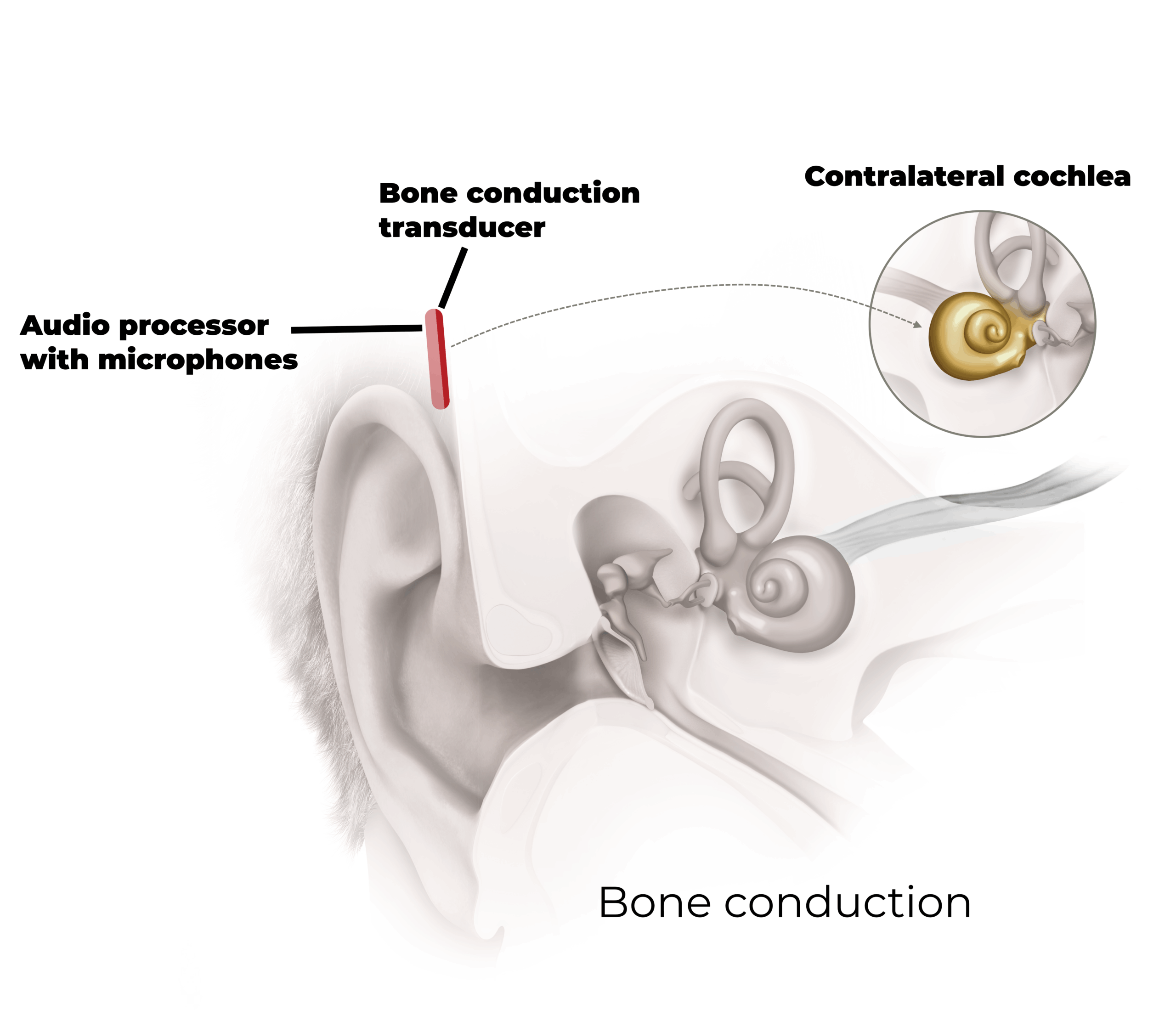
This section outlines the benefits and drawbacks of bone conduction solution, categorized into three key domains: audiological aspect, medical aspect, and patient-reported aspects.
Each publication listed below is rated by its importance for patients, using a Hearring key icon scale 🔑— one key for low importance, three keys for medium importance, and five keys for high importance.
🔑 low importance for patients
🔑🔑🔑🔑🔑the highest importance for patients
Benefits
Audiological Aspects
🔑🔑🔑🔑
1. “Speech audiometry showed a significant head shadow benefit with both implantable bone conduction devices.” (Desmet et al. 2012)
More: Van de Heyning et al. 2016, Hol et al. 2010, Mertens et al. 2018
🔑🔑🔑🔑
1. “Bone-anchored hearing aid systems transmit sound to the better side by bone conduction (BC). (…) Several studies have shown significant speech understanding improvement and improvement of quality of life for SSD.” (Laske et al. 2015)
2. “Mean speech recognition scores in noise improved significantly under various signal-to-noise ratio (SNR) for both groups.” (Oh
et al. 2020)
More: Mertens et al. 2018, Snapp et al. 2019, Salcher et al. 2017, Van de Heyning et al. 2016, Yuen et al. 2009, Lin et al. 2006
🔑🔑🔑🔑
1. “The median WRS at 65 dB SPL increased significantly from 0 to 80% (mean: 8% versus 84%).” (Salcher et al. 2017)
2. “WRS in quiet improved significantly on average by 70% in SSD and 53% in MCHL relative to the unaided condition (p < 0.01)”.
More: Siegert et al. 2013
🔑🔑🔑🔑
1. “Both patients with MCHL and patients with SSD had subjective satisfaction and improved quality of life with [Bonebridge].” (Oh et al.2019)
2. “Bone-anchored hearing aid systems transmit sound to the better side by bone conduction (BC). (…) Several studies have shown significant speech understanding improvement and improvement of quality of life for SSD.” (Laske et al. 2015)
3. “Nearly all patients experienced a subjective benefit in all hearing situations assessed with the BBSS (9/10). There was a significant improvement in the categories speech in quiet, distant speaker, reverberant room, and overall.” (Salcher et al. 2017)
More: Van de Heyning et al. 2016, Boleas-Aguirre et al. 2012, Desmet et al. 2014, Oeding et al. 2013, Peters et al. 2015, Gerdes et al. 2014,
Medical Aspects
Patient-reported Aspects
🔑🔑🔑🔑
1. “A CROS conducts signals from the hearing field of the poor ear via a wire (or FM/Bluetooth) to a microphone in the ear canal of the better ear. (…) A [bone conduction device] transfers signals from the hearing field of the poor side to the better hearing ear by vibration of the bone of the skull.” (Peters et al. 2014)
More: Hol et al. 2005
🔑🔑🔑🔑
1. “A trial with a bone conduction device] can be performed by attaching the [bone conduction device to a tight headband.”
More: Spielman et al. 2018, Mertens et al. 2016, Desmet et al. 2012, Hol et al. 2010, Kompis et al. 2011, Wendrich et al. 2017, Rainsbury et al. 2016
🔑🔑🔑🔑
1. In children, a fairly rapid hearing rehabilitation period is important since they may, after a fairly short time, lag behind in school or in development since they frequently cannot follow classroom activities or social interactions (conclusion / Tomlinet al. 2014)
More: Mertens et al. 2018, Urik et al. 2019, Bovo et al. 1988
Drawbacks
Audiological Aspects
🔑🔑🔑🔑🔑
1. “The CROS and bone-anchored hearing aid treatment […] do not allow for real binaural hearing because the brain only receives and processes auditory input from one side.” (Arndt et al. 2011)
2. “Importantly, these treatment options are unable to provide any binaural hearing benefits.” (Snapp et al. 2019)
3. “Theoretically, CROSS and BCD can alleviate the head shadow effect and thus improve speech perception in noise and sound localization, and they also may have a beneficial influence on quality of life. However, both modalities do not restore binaural hearing.”
More: Agterberg et al. 2019, Battista et al. 2013, Hol et al.2005, 2010, Hobson et al. 2010
🔑🔑🔑
1. “Sound-localization performance of patients with single-sided deafness is not improved when listening with a bone-conduction device.” (Agterberg et al. 2019)
🔑🔑🔑
1. “However, for people with severe to profound sensorineural hearing loss, hearing aids and other forms of sound enrichment are not useful for tinnitus treatment. In recent years, patients with severe to profound hearing loss have sought cochlear implantation as a means of tinnitus relief when other treatments were found to be ineffective.” (Holder et al. 2017)
Medical Aspects
🔑🔑🔑
1. “The sequence for metal artifact reduction optimized in Bern enables MRI at 1.5 T in patients with active transcutaneous bone conduction implants without sacrificing diagnostic imaging quality.” (Wimmer et al. 2019)
2. “Metallic implants are a significant concern because of their interaction with the complex MR environment, which can introduce significant force, voltage, heat, image artifact, demagnetization, and potential device malfunction.” (Shew et al. 2019)