

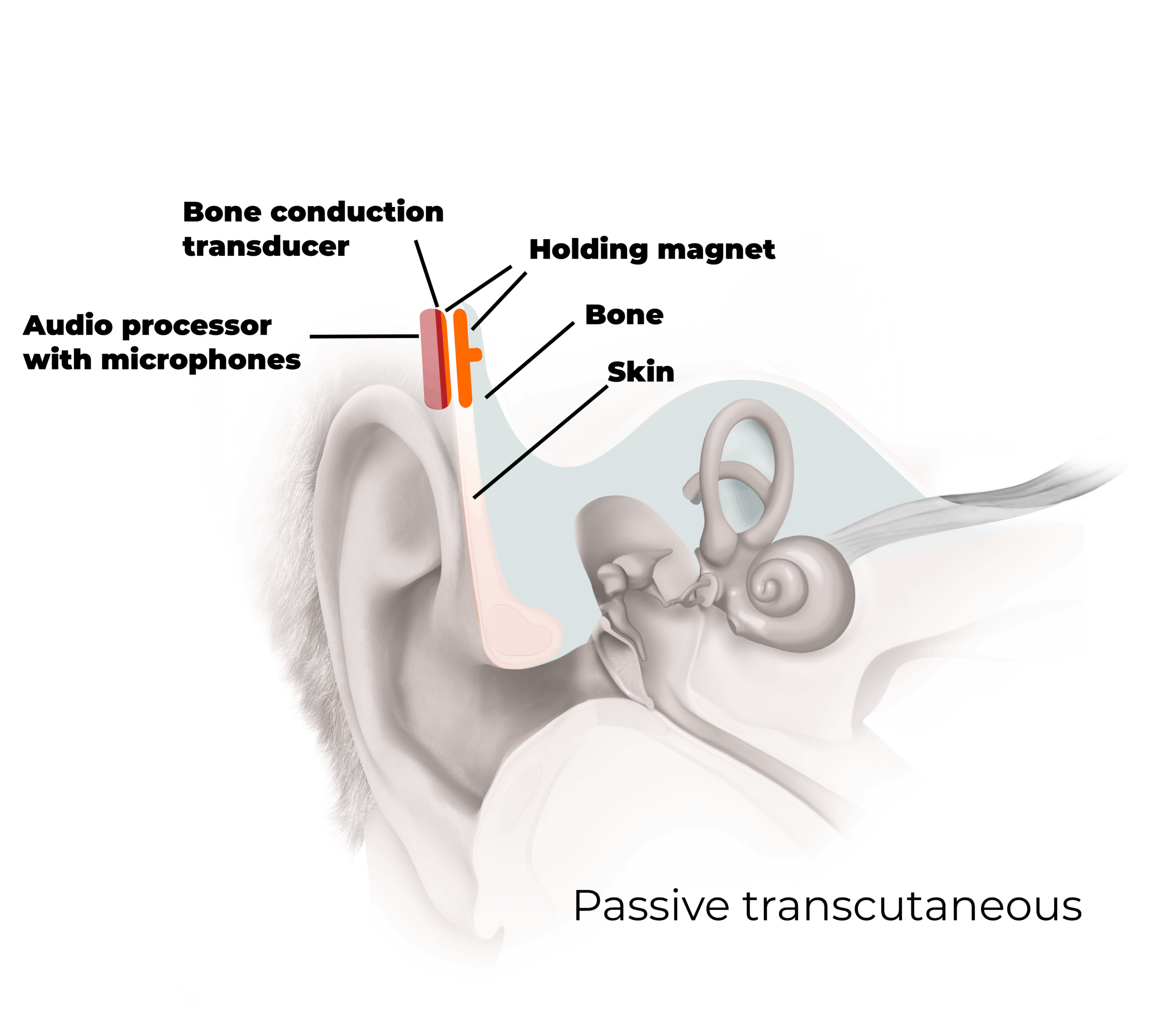
Passive transcutaneous
This section outlines the benefits and drawbacks of a passive transcutaneous solution, categorized into three key domains: audiological aspect, medical aspect, and patient-reported aspects.
Each publication listed below is rated by its importance for patients, using a Hearring key icon scale 🔑— one key for low importance, three keys for medium importance, and five keys for high importance.
🔑 low importance for patients
🔑🔑🔑🔑🔑the highest importance for patients
Benefits
Audiological Aspects
🔑🔑🔑🔑
1. “Overall, the [passive transcutaneous bone conduction hearing implants] demonstrated good audiological outcomes with a mean PTA gain of 28.4 ÷2.1 dB and SRT gain of 32.9 ÷3.9 dB. ” (Cooper et al. 2017)
Medical Aspects
🔑🔑🔑🔑
1. “(…) the passive transcutaneous skin-drive [bone conduction devices] contain implanted magnet(s).” (Reinfeldt et al. 2015)
2. “The skin condition remains intact in all the cases.” (Dolhen et al. 2020)
3. “The processed sound in the audio processor produces the vibration of the external magnet, which vibrates the implanted magnet by inducing a magnetic field through the intact skin.” (Gavilán et al. 2015)
More: Cooper et al. 2017
🔑🔑🔑🔑
1. “The implanted magnets of the abutment-free Alpha systems have been classified as MR Conditional in 3-Tesla MR systems ( …) To avoid overheating of the internal magnet, patients should not undergo more than 15 minutes of continuous scanning per pulse sequence. The external sound processors of the Alpha abutment-free systems are MR Unsafe and should be removed prior to entering the MRI suite area.” (Azadarmaki et al. 2014)
More: Tisch 2017
Patient-reported Aspects
Drawbacks
Audiological Aspects
🔑🔑🔑🔑
1. “Compared with percutaneous bone-conduction stimulation, transcutaneous stimulation demonstrated reduced effective gain, decreased phoneme recognition, word recognition, and performance in noise, with the most significant impact observed for soft speech inputs.” (Snapp et al. 2019)
2. “Given the lower thickness of the internal magnet, the Sophono ™ system might be more suitable for younger children, whereas [bone anchored hearing aids] offered better functional results. Both systems can be considered valid and safe options for the functional rehabilitation of conductive hearing loss in children, provided that precautions are observed, such as a gradual use of the device and use of the least powerful magnets in the first months after the activation.” (Giannantonio et al. 2018)
3. “Bonebridge (BB) and Sophono (SP) devices improved hearing; with the [Bonebridge] implant showing a better performance at medium and high frequencies. Furthermore, the (Bonebridge], as an active implant, showed higher functional gain and increased time of use, when compared to the (Sophono], a passive system.” (Zernotti et al. 2016)
Medical Aspects
🔑🔑🔑🔑
1. The implanted magnet of passive transcutaneous bone conduction devices is causing artefacts on MR images.
(HEARRING consensus)
2. “(…) artifacts related to the presence of metallic implants can affect the diagnostic use of MRI, especially when implants (….)
contain magnets. (Azadarmaki et al. 2014)
🔑🔑🔑🔑
1. “The minor complication rate was 13.1%. In total, the complication rate for [passive transcutaneous bone conduction hearing implants] was 18.3%. ” (Cooper et al. 2017)
Patient-reported Aspects
🔑🔑🔑🔑
1. “The high profile of the audioprocessor is more prominent than other implant categories and might interfere with headwear.” (HEARRING consensus)
🔑🔑🔑🔑🔑
1. “A typical pressure is at least 2 N which most often gives discomfort and problems in the skin and subcutaneous tissues between the transducer and the bone if used long-term. The high static pressure can also give tension headaches.” (Reinfeldt et al. 2015)
2. Den Besten et al showed, that 20% of 36 individuals reported numbness and 38% some degree of pain/discomfort at 6 months after surgery. (conclusion / den Besten et al. 2020)
3. “When increased pressure on skin is used to improve the effect, the skin may be irritated, red and itchy, leading to significant discomfort. Skin necrosis was also reported.” (Urik et al. 2019)
4. In the study by Kruyt et al 4 of 11 SSD patients became non users within 24-months after surgery. In total 9% reported numbness and 15% (slight) pain or discomfort. (conclusion /Kruyt et al. 2020)
More: Cooper et al. 2017