

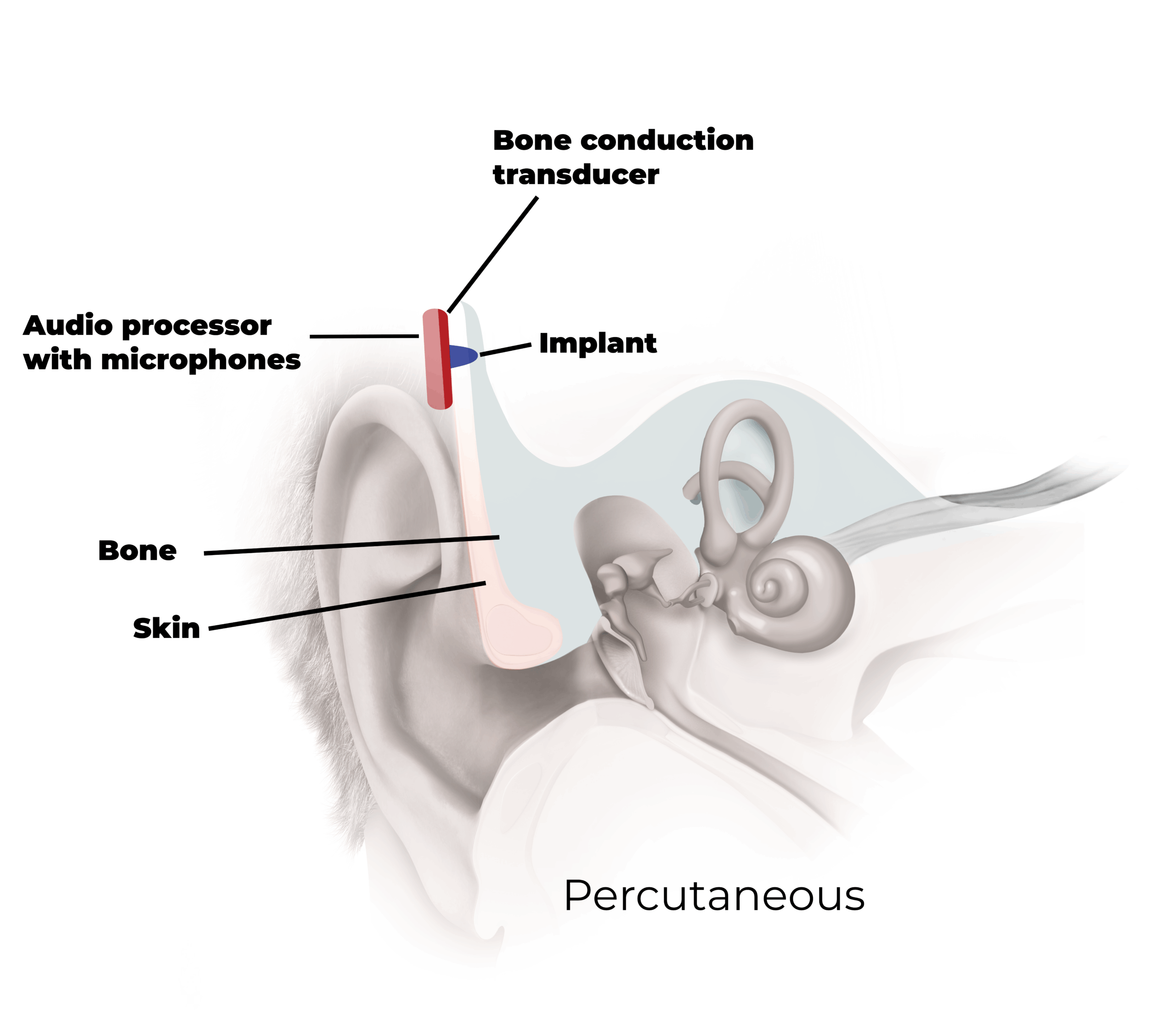
Percutaneous
This section outlines the benefits and drawbacks of a percutaneous solution, categorized into three key domains: audiological aspect, medical aspect, and patient-reported aspects.
Each publication listed below is rated by its importance for patients, using a Hearring key icon scale 🔑— one key for low importance, three keys for medium importance, and five keys for high importance.
🔑 low importance for patients
🔑🔑🔑🔑🔑the highest importance for patients
Benefits
Audiological Aspects
🔑🔑🔑🔑
1. “Hearing gain is defined as the difference between preoperative and postoperative PTA. The weighted hearing gain for 516 atresiaplasty patients in 14 studies was 24.1 dB (95% Cl, 23.4-24.7) compared with 38.0 dB (95% Cl, 35.3-
40.7) for 100 [osseointegrated bone conduction devices] patients in 5 studies. The difference in the hearing gain between atresia surgery and losseointegrated bone conduction devices) was significant (p < 0.001).” (Nadaraja et al. 2013)
2. “The 2 studies that looked at losseointegrated bone conduction devices] for [congenital aural atresia] on the other hand had a 98.2% (95% Cl, 94.5%Y100.0%) closure of the ABG less than 30 dB in 47 patients. The difference in the ABG between 2 surgeries was significant (p < 0.001).” (Nadaraja et al. 2013)
3. “Audiological outcomes were discussed in 20 publications.
Improvement against the unaided thresholds was demonstrated. The functional improvement was on average 33.9 dB. The effective gain, or remaining air-bone-gap was on average 6.7 dB. All evaluated data showed aided speech reception thresholds significantly below normal speech level.” (Lagerkvist et al. 2020)
4. “These devices use an osseointegrated percutaneous titanium implant to transmit sound vibrations generated by an external audio processor to the temporal bone. These devices have been well studied and have excellent audiometric results.” (Cooper et al. 2017)
More: Janssen et al. 2012, Goycoolea et al. 2020, Gerdes et al. 2016, Kruyt et al. 2020
Medical Aspects
🔑🔑🔑🔑
1. “The fixture and abutment are made out of titanium, which is a paramagnetic metal. They are approved for use (i.e., MR
Conditional) in 3.0-Tesla MR systems. The external processor is ferromagnetic and must be removed before scanning.”
2. “Percutaneous bone anchored hearing implants are compatible with magnetic resonance imaging although image artifact around the osseointegrated titanium implant does occur (15.1-17.4 mm)” (Doshi et al. 2013)
More: Arndt et al. 2007, Tisch 2017
Patient-reported Aspects
Drawbacks
Audiological Aspects
🔑🔑🔑🔑
1. “(…) [percutaneous bone conduction devices] are known to have limited gain due to feedback problems. Feedback oscillations occur when increasing the gain over a certain point as sound is radiated back from cranial bone and housing to the microphone.”
2. “Main acoustic shortcomings included wind noise, speech in noise, and feedback.” (Medical Advisory Secretariat 2002)
More: Busch et al. 2015
Medical Aspects
🔑🔑🔑🔑
1. “During a mean follow-up of 39 months (range, 0 to 144 months), 16 of the 248 implants were lost (6.5%). The causes were failed osseointegration in 9 cases, trauma in 6 cases, and implant loss in irradiated bone in 1 case.” (de Wolf Maarten et al. 2009)
2. “Osseointegrated implants require frequent maintenance care from the surgeon. Complication rates are higher for children with a diagnosis of a craniofacial syndrome, and the risk of a complication increases significantly over a prolonged period of time.” (Ida et al. 2011)
More: Wazen et al. 2008
🔑🔑🔑🔑🔑
1. “The percutaneous abutment connection system is disadvantageous in terms of aesthetics, and regular hygiene and care of the surgical site are necessary.” (Cho et al. 2020)
2. “Most patients found it unpleasant (…) to have an abutment in their skull that required diligent care.” (Müller-Isberner et al. 2015)
More: Cooper et al. 2017, Lindsey 2009
Patient-reported Aspects
🔑🔑🔑🔑🔑
1. “Multiple studies reported postoperative skin irritations and wound infections due to the permanent skin penetration of the fixation screw.” (Schilde et al. 2017)
2. “Surgically implanted bone anchored hearing aids that are directly anchored in the temporal bone circumvent these problems, but their use is associated with an increased risk of dermatological complications due to the penetration of the skin surface necessitating constant wound care.” (Skarzynski et al. 2019)
3. “Approximately 20% of the patients suffered from skin irritations and in 5% of the cases surgical interventions were necessary to rehabilitate the skin complications.” (de Wolf Maarten et al. 2008)
4. In this study with over 600 patients the Baha complication rate was 23,9%. (conclusion / Hobson et al. 2010)
5. Schwab et al. showed, that complications with a percutaneous device that necessitate revision surgery are also high – rates vary between 5,8% and 12,1% of cases. depending on study (conclusion / Schwab et al. 2019)
6. “Although some complications seem to decrease with new implant systems, one main issue is that it needs lifelong daily care.”
7. Reyes et al. found that 30% of the patients with either an osseointegrated percutaneous bone conduction hearing implant or auricular prosthesis had at least one adverse skin reaction (conclusion / Reyes et al. 2000)
More: Shirazi et al. 2006, Wazen et al. 2008, Gluth et al. 2010, Shapiro et al. 2018, Kiringonda et al. 2013, Dun et al. 2012, Peters et al. 2014