

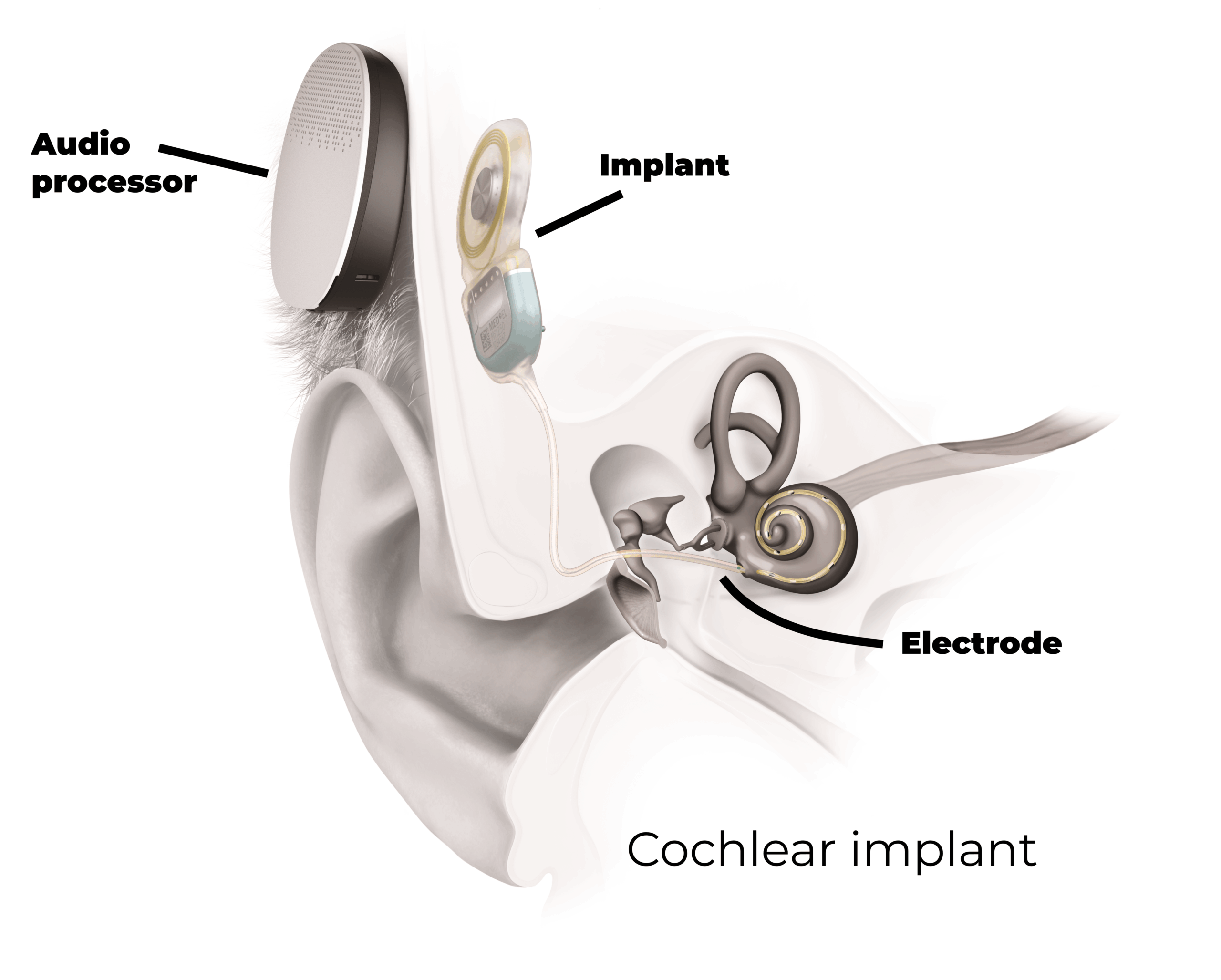
Cochlear Implant
This section outlines the benefits and drawbacks of a cochlear implant, categorized into three key domains: audiological aspect, medical aspect, and patient-reported aspects.
Each publication listed below is rated by its importance for patients, using a Hearring key icon scale 🔑— one key for low importance, three keys for medium importance, and five keys for high importance.
🔑 low importance for patients
🔑🔑🔑🔑🔑the highest importance for patients
Benefits
Audiological Aspects
🔑🔑🔑🔑🔑
1. “Cochlear implants (CI) are an emerging treatment option for SSD (the use of cochlear implants for specific labeling/indications varies by region, and may not be approved or may be subject to restrictions by region), providing direct electrical stimulation to the deafened ear via an electrode placed in the impaired cochlea. Because they provide direct input to the impaired ear, independent stimulation of each ear may provide some binaural hearing benefits not realized with rerouting solutions.” (Snapp et al. 2020)
2. “The Cl improved localization accuracy and reduced side bias. […). The Cl improved masked sentence recognition when the masker was presented from the front or from the side of normal or near-normal hearing. […] Cl benefits were consistently observed across individual subjects.” (Buss et al. 2018)
3. “A Cl is the only device that can restore auditory input in the deafened ear and provide the user with access to the binaural hearing system.” (Kurz et al. 2020)
4. “The post-Cl developmental trajectory provided clear evidence of age-appropriate development of auditory cortical responses, and decreased cross-modal reorganization, consistent with improved speech perception and sound localization. Post-Cl, the child [with SSD] demonstrated age-appropriate auditory cortical development and improved speech perception and sound localization suggestive of significant benefits from cochlear implantation.” (Sharma et al. 2016)
More: Tavora-Vieira et al. 2013, Lorens et al. 2019, Polonenko et al. 2017, Finke et al. 2017, Peters et al. 2018, Arndt et al. 2011, 2017, First et al. 2012, Blasco et al. 2014
🔑🔑🔑🔑🔑
1. “[ln the structured interviews of SSD Cl participants,] increased engagement in social activities since implantation was mentioned as well as social withdrawal preimplantation (e.g. return to an active social life after C/ switch-on, higher self-confidence).” (Finke et al. 2017)
🔑🔑🔑🔑
1. “Cis provide listeners with unilateral deafness important benefits for speech perception in complex spatial environments, including a larger head-shadow benefit when speech and noise originate on opposite sides of the head.” (Bernstein et al. 2017)
2. Tavora-Vieira et al. (2013) observed significant improvement in speech in noise scores for 3 challenging spatial configurations (conclusion / Tavora-Vieira et al. 2013)
3. “For adults with SSD or AHL I…] who had post-lingual onsets of the profound loss in the non-hearing ear, I…] the addition of the Cl enables binaural hearing with positive and highly significant effects of binaural summation, head shadow, and binaural squelch.” (Lorens et al.2019)
4. “Binaural benefit analysis showed significant improvement with head shadow effect, which likely provides ease of listening.” (Sullivan et al. 2019)
More: Kitoh et al. 2016, Kurz et al. 2020, Buss et al. 2018, Mertens et al. 2016, Arndt et al. 2017, Rahne et al. 2016, Hansen et al. 2013, Mlynski et al. 2012, Tavora-Vieira et al. 2019
🔑🔑🔑🔑
1. Literature shows a statistically significant improvement of localisation abilities after Cl implantation, but the duration of deafness influences the results (HEARRING consensus)
2. Tavora-Viera et al showed that “adults with >25 years of unilateral deafness obtained speech perception scores and subjective outcomes that are similar to those attained by individuals with normal hearing and/or those with bilateral Cl”. (conclusion / Tavora-Vieira et al. 2013)
3. “Cochlear implantation for SSD can offer improved speech understanding in complex listening environments and improved sound source localization in both children and adults.” (Zeitler et al. 2015)
4. “Significant Cl benefits were observed for tinnitus severity, localization, speech understanding, and QoL.” (Galvin et al. 2019)
More: Buss et al. 2018, Mertens et al. 2016, Tavora-Vieira et al. 2016, Arndt et al. 2017, Lorens et al. 2019, Großmann et al. 2016, Blasco et al. 2014, Erbele et al. 2015, Kurz et al. 2020, Ehrmann-Müller et al. 2020
Medical Aspects
🔑🔑🔑🔑
1. “Patients undergoing 1.5 T MRIs with devices including a diametrically bipolar magnet or a rigid implant screw fixation, experienced no pain, even without headbands. ” (Todt et al.2018)
2. Intraindividual artifact size differences between the three magnets and are smaller than interindividual maximum artifact size differences. 3 T MRI scans, in comparison to 1.5 T MRI scans, show a difference between soft artifact areas.
Conclusion: We observed no major difference between maximum implant magnet artifact sizes of the three implant magnet types. “
More: Wimmer et al. 2019, Bawazeer et al. 2019, Azardamaki et al. 2014
Patient-reported Aspects
🔑🔑🔑🔑
1. “Patients undergoing 1.5 T MRIs with devices including a diametrically bipolar magnet or a rigid implant screw fixation, experienced no pain, even without headbands. ” (Todt et al.2018)
2. Intraindividual artifact size differences between the three magnets and are smaller than interindividual maximum artifact size differences. 3 T MRI scans, in comparison to 1.5 T MRI scans, show a difference between soft artifact areas.
Conclusion: We observed no major difference between maximum implant magnet artifact sizes of the three implant magnet types. “
More: Wimmer et al. 2019, Bawazeer et al. 2019, Azardamaki et al. 2014
🔑🔑🔑
1. Bess et al. (2014) showed how exhausting listening with SSD can be and the benefit a Cl can bring. (conclusion / Bess et al. 2014)
🔑🔑🔑🔑
1. McKay (2010) states, that getting access to the advantages of binaural hearing, leads to increased listening and language acquistion. (conclusion / McKay 2010)
More: Buss et al. 2018, Dirks et al. 2019, Tavora-Vieira et al. 2015
🔑🔑🔑🔑
1. During the period of development, binaural hearing is even more important in young children than it is in adulthood. As shown in longitudinal studies, pediatric [unilateral hearing loss] can lead to significant psychosocial difficulties and school problems (…)
(conclusion / Lieu et al. 2012)
🔑🔑🔑🔑
1. “Furthermore, cochlear implantation in patients with SSD and additional tinnitus was successful for tinnitus reduction and able to improve quality of life.” (Prejban et al. 2018)
2. “Responses from 14 (SSD) participants accounted for a substantial change in their quality of life after Cl activation.
(…) With respect to working life, (SSD) Cl users state that prior to implantation they had the feeling to be no more capable of pursuing their job in the same way as before their [hearing loss) (…) The return to an active social life, privately and professionally, increased the perceived self-value of all participants.” (Finke et al. 2017)
3. “In this study, older adults with more than 25 years of unilateral deafness obtained scores in speech perception testing and in subjective evaluation that are similar to those attained by individuals with normal hearing and/or those with bilateral cochlear implants.” (Tavora-Vieira et al. 2013)
4. Cloutier et al. (2014) showed great quality of live benefits and significant improvement in audiologic performance as seen in speech recognition scores (conclusion Cloutier et al. 2014)
More: Vermeire et al. 2009, Arndt et al. 2011, Kleine Punte et al. 2011, Dillon et al. 2017, Mertens et al. 2016, Tavora-Vieira et al. 2019, Finke et al. 2017
🔑🔑🔑
1. “Music enjoyment from electric stimulation is extremely poor relative to a readily interpretable [normal hearing] baseline for
CI-SSD listeners. However, the combination of this unenjoyable signal presented through a Cl and an unmodified acoustic signal presented to a [normal hearing] (or near-[normal hearing]) contralateral ear results in enhanced music enjoyment with respect to the acoustic signal alone.” (Landsberger et al. 2019)
2. Brockmeier (2011) found that SSD Cl users listen to music with their implants, that music has a greater role in their lives following implantation, and that overall, music activities are enhanced after implantation. (HEARRING consensus)
3. “For all objective tests of music discrimination and speech perception in noise, there were no statistically significant differences between MED-EL and Cochlear Cl systems.
Subjectively, four subjects thought their MED-EL device was better than their Cochlear device for music appreciation. Four thought that music sounded more natural, less tinny and more reverberant with their MED-EL Cl than with their Cochlear Cl.” (Harris et al. 2011)
More: Todd et al. 2017
🔑🔑🔑🔑
1. “Electrical Stimulation via a Cl resulted in a significant reduction in tinnitus loudness (…).” (Van de Heyning et al. 2008)
More: Häußler et al. 2019, Liu et al. 2018, Dillon et al. 2017, Tavora-Vieira 2015, Mertens et al. 2015, 2016, Peter et al. 2019
Drawbacks
Audiological Aspects
🔑🔑🔑🔑
1. “The rapid increase of hearing-related QoL after 3-6 months … indicates that our patients had little problems with adapting to the new hearing sensation provided by the Cl.” (Muigg et al. 2019)
2. “An interesting finding is that in our case series even patients with long-standing deafness (..) were able to rapidly integrate the electric stimulation into their acoustic normal hearing, and to improve their speech perception scores in complex listening conditions as early as at 3 months post implantation.” (Tavora-Vieira et al. 2013)
3. “Another factor that may contribute to the early and consistent benefit observed for Cl recipients in the present study is the relatively deep insertion of the (..) standard electrode array. Monaural speech perception and binaural processing can be degraded by a shift in the mapping of place to frequency. ” (Buss et al. 2018)
4. “Relatively accurate and asymptotic pitch perception was observed at the 1-month interval, indicating either very rapid acclimatization or the provision of familiar place and rate cues. Early availability of appropriate pitch cues could have played a role in the early improvements in localization and masked speech recognition previously observed in this cohort.” (Dillon et al. 2019)
More: Ehrmann-Müller et al. 2020, Thomas et al. 2017, Dorman et al. 2019
Medical Aspects
🔑🔑🔑
1. “After implantation, the surgeon is responsible to organize and perform a life-long follow-up. It refers to the technical checkup as well as the settings of the implants. Furthermore, regular updates of the software and hardware are necessary since they make progress of the implant technology useable for the patients. ” (Lenarz 2018)
🔑🔑🔑🔑
1. “Congenital deafness (n= 24). More than 50% (n=14) of the congenitally deaf children showed aplasia / hypoplasia of the cochlear nerve in MRI; therefore they did not qualify for Cl surgery” (Arndt et al. 2015)
🔑🔑🔑
1. “Imaging artifact only very rarely impedes adequate visualization of the ipsilateral IAC or CPA in Cl recipients. In anticipation of the need for further IAC and CPA imaging, it would be advisable to place the receiver in an exaggerated superior-posterior position to further decrease obscuring artifact.” (Schwartz et al. 2020)
2. “Metallic implants are a significant concern because of their interaction with the complex MR environment, which can introduce significant force, voltage, heat, image artifact, demagnetization, and potential device malfunction.” (Shew et al. 2019)
Patient-reported Aspects
🔑🔑🔑🔑
1. “Nevertheless, several studies have defended the importance of intensive auditory training in order for all Cl users with SSD, regardless of age, to achieve optimal outcomes.” (Tavora-Vieira et al. 2019)
🔑🔑🔑🔑
1. “Electrical Stimulation via a Cl resulted in a significant reduction in tinnitus loudness (…).” (Van de Heyning et al. 2008)
More: Häußler et al. 2019, Liu et al. 2018, Dillon et al. 2017, Tavora-Vieira 2015, Mertens et al. 2015, 2016, Peter et al. 2019